The Therapeutic Effect of Trail Running
Within the animal world, humans are physically remarkable primarily for one thing: our ability to run, persistently, over extraordinary distances. It is not surprising, then, that we are drawn to exploratory movement—there is something intrinsic to it, rooted in what defines us as a species. Endurance running is biologically ingrained in us, and combined with our relentless curiosity, it becomes the natural medium through which we ought to move.
Nowadays, even though we enjoy the luxuries of modern life and no longer depend on our physical abilities to survive, we still long for its natural benefits. Yet we are drawn to running not merely for motion's sake, but for the freedom and peace it provides. Routine and repetition, while comforting to some, can quietly drain the spirit. The pursuit of novelty—the thrill of landscapes that shift and surprise, the rigors of changing terrain, the hardships the body endures—reminds us that life is lived most fully at its edges. The measure of an experience is not found solely in performance, but first and foremost in the journey it provides: the way it awakens the senses and stretches perception, both within and without.
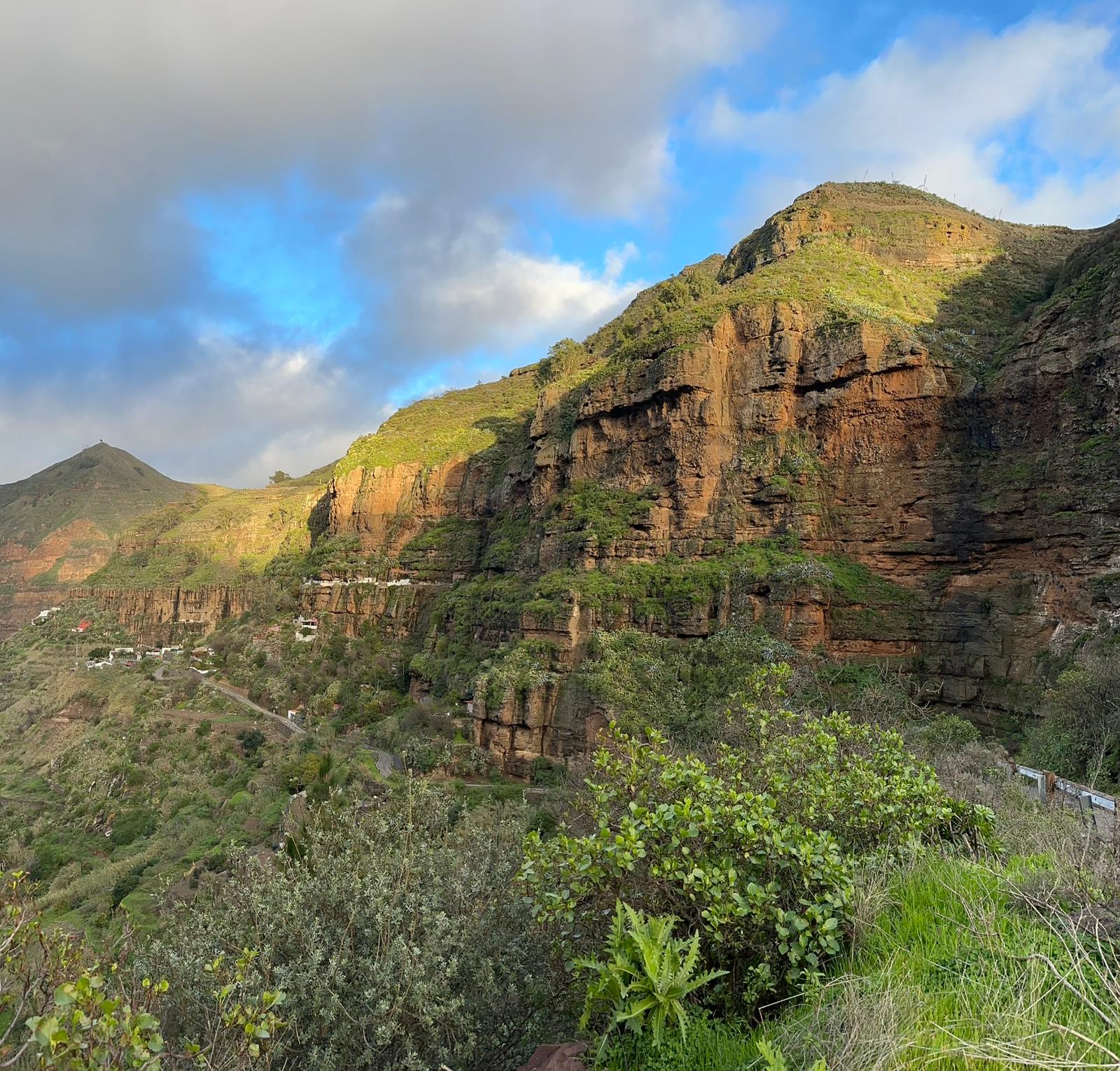
During my stay on the island of Gran Canaria, a recent run took me toward Roque Bermejo, from where I turned right in the direction of Tamadaba. The recent rains had left the landscape lush and abundant. After a steep ascent along the rocky trail, I reached the upper plateau, where pine trees dominated and I soon disappeared into cloud. The path widened and descended on the other side, taking me back down toward the artificial lakes of Presa de los Pérez, and then further still to the village of El Hornillo. There, bathed in evening sunlight, dwellings were carved into the softer tuff layer of otherwise hard basaltic rock that formed the steep cliffs. Water dripped from countless places, and the narrow valley was carpeted with opulent greenery. The beauty was startling, and I could feel the sublimity of the place.
The big brother of trail running is undeniably hiking for both share a similar objective: immersion in nature for the therapeutic qualities it provides. And yet, there seems to be a persistent misunderstanding about why some choose to run instead of simply walk. This distortion might stem from a culture driven by performance, one that misses the fundamental appeal. It is true that competition plays a major role in the sport—it is in our nature to measure what can be measured, reflecting both our competitive instincts and our playfulness. But to narrow trail running solely to physical performance is to do it an injustice. A technical path downhill requires our full attention as a misstep could have severe consequences, forcing our mind to stay in the present moment and thus intensifying the experience as it cannot wander elsewhere. Packing only the necessary enables us to realize what is truly essential and what is carried merely to give us a sense of security. We may gain confidence as we recognize how little is needed, and with experience growing, we take further joy in the liberty of carrying less on our shoulders. There is pleasure in feeling the wind against our face as we rush down, the lightness in our movements reminiscent of a child at play. Thus it is more than mere motion; it is a vivid encounter with the world, and with ourselves.
I try to thread down the valley of Agaete but eventually come to a halt as the uniqueness of the moment becomes evident. I am reminded of what makes me come alive: the presence of beauty and the sublime. I am blessed by the recent rains that have painted this remote dell in vibrant, verdant hues. The weight of my regrets at that time—centered on the loss of a recent, brief but deeply intense friendship—begins to lift. What my mind already knew, my soul now finally integrates. It is as if the cliffs, in their timeless magnificence, are laughing at me, saying: why are you concerned with what is beyond your control? Why resist what cannot be altered? You have grieved, you have learned. You have suffered enough. Now let go, for life is too beautiful for lingering in sorrow.
It is not to say that trail running is superior to any other sport, but to appreciate what it provides beyond its physical benefits. Mind, body, and soul are intrinsically linked, and when surrounded by the ever-forgiving, non-judgmental nature and confronted with physical exhaustion, a space is created to see what might otherwise remain hidden. For the more sensitive among us, this can be frightening, and we may find ourselves crying for what we have been holding in our chest — now finally able to be released, finally felt. In those moments, we need to accept what is happening within ourselves, not fight it, but allow it to pass. For it is a blessing to be connected to our inner parts, to no longer run away from what might have been stored deep inside. And at the end of the experience, clarity will remain.
I stand at the Refugio de Hornillo, from where a narrow path leads back to Agaete along the widening barranco. I take a few deep breaths and turn around, not wanting to miss any detail—as if trying to grasp the deeper layers of a painting, to understand its meaning, its core message. Only when darkness slowly takes over do I finally focus entirely on the running, my heart lightened and the air gradually warming up as I descend closer to the coast.
Covering great distances while fully immersed in nature, the awakening of the senses and the lightness of carrying so little—these provide a specific kind of freedom, one that heals precisely because it demands our complete presence. What we carry back is not merely exhaustion and the satisfaction of having seen new places, but also a quiet transformation: the clarity and peace that come from confronting ourselves.