The mental benefits of deep breathing
A great majority of people will say that life is accelerating the older they get, that the years seem to slip away and before they realise, ten seasons will have passed. This is partly due to a change of perception, in other words, how we experience time. With our life being in constant hustle and our attention distracted by the firm grip of our digital devices, we do not take the time to contemplate the recent past. Too agitated is our mind to stay focused, to simply revisit what was lived. Yet, its exploration can extend our lives significantly as we take notice of forgotten memories – its formation not merely dependent on the occurrence of events, but on the depth of attention we bring to them. When the mind races perpetually forward—planning, anticipating, responding to endless notifications—it registers only superficially. The impressions we gather pass through us without leaving lasting imprints. The weeks blur together not because nothing happened, but because we were not truly present when it did.
This is where the practice of conscious breathing reveals its unexpected value. The Wim Hof method, named after the man who created it, with its cycles of deep inhalation and prolonged retention, provides more than mere physiological training. It serves as an anchor, pulling awareness back into the immediate present. During those thirty to fifty deep breaths and the subsequent holding before the beginning of the next cycle, there is no room for distraction. The body demands full attention—the rhythm of air moving in and out, the tingling in the extremities as our blood becomes more alkaline, the subtle shifts in consciousness as the practice unfolds. The mind, so accustomed to wandering, finds itself naturally tethered to something undeniably real: the breath, the body, the present moment.
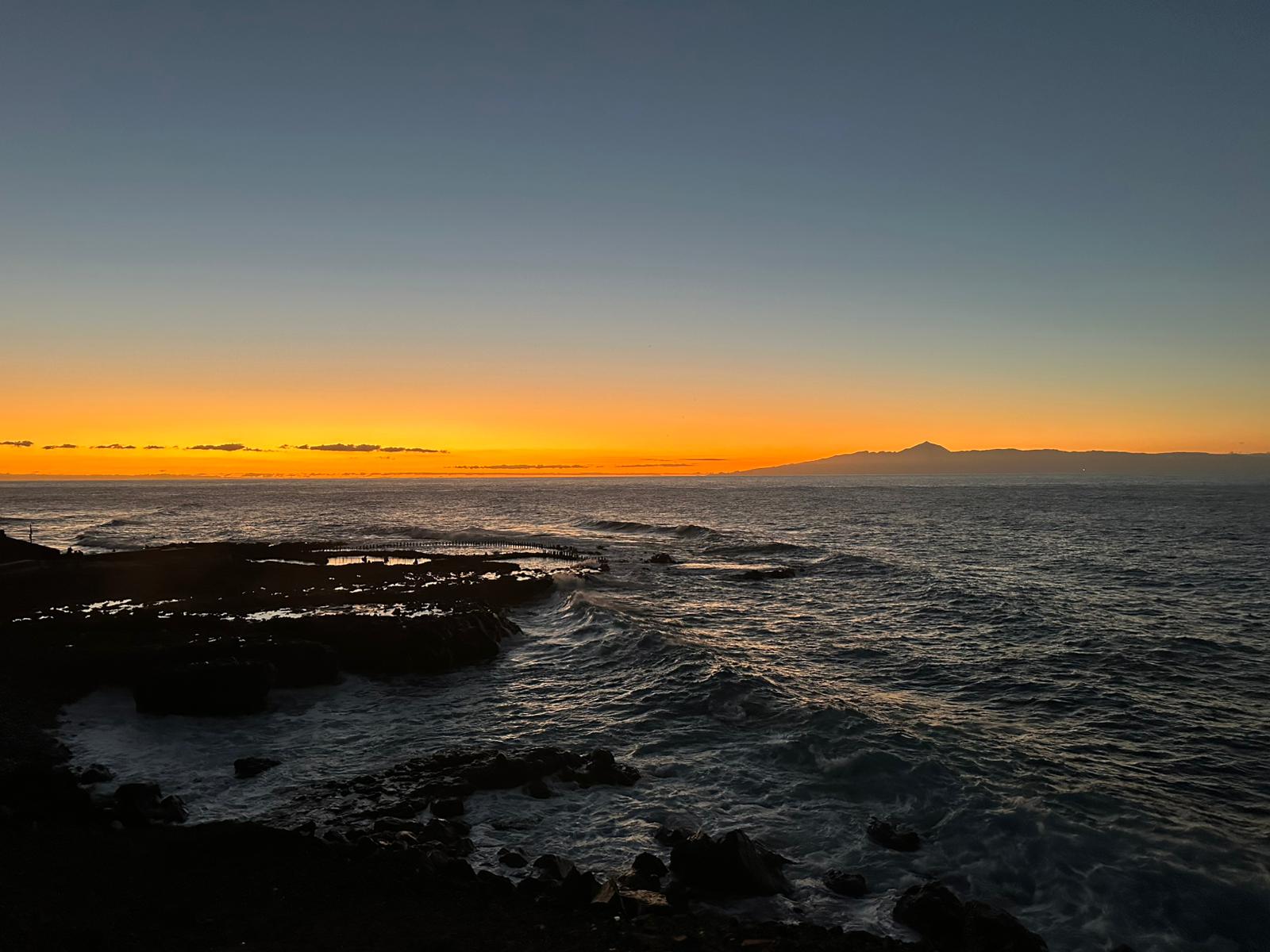
After an evening swim at the port of Agaete, I walk back along the natural pools and up the stairs before coming to a halt. The sun is about to set, the air is warm, and the relentless crashing of the waves against the cliffs invites me to sit down and admire the stunning scenery unfolding before my eyes. I settle at the edge of a cliff, the snowy peak of the Teide visible in the distance and the natural basins directly below, while the sky slowly surrenders to its daily colorful spectacle. Forty times I breathe in and out, then hold the air for as long as it feels comfortable. As I repeat the cycles, I feel the familiar tingling in my cheeks, toes, hands, and belly. Naturally, without forcing, the mind settles and the senses sharpen. I see clearly the lines of waves coming in, their endless battle as they climb up the rocks before retreating back into the ocean. I hear with greater clarity the sounds around me. I notice the changing colors of the waves, the reflection of the twilight’s colorful hues in the basins, the moving clouds in the distance, and the gradual awakening of the town's lights.
And while the mind is present, past memories may resurface, gently, allowing us to relive them a second time. We stray through a set of images, scents, and emotions. We might reflect on its meaning, how it might have changed us, how it influenced us in ways we haven't yet considered. And more importantly, we allow ourselves to live it all again, savor it, and thus etch it ever deeper into our memory. At times, neglected emotions buried deep within us may resurface naturally, and we may find ourselves vulnerable. Yet tears are the gateway to our souls, and we should not be afraid to let them flow. Acknowledging them suffices, and perhaps with time we may understand the reasons for their appearance—not that we drown in them, but rather navigate safely through the waters.
It is late evening and I sit on my mattress in my bedroom. I have placed two candles on my desk to serve as a focal point during my cycles. Next to my bed, two more candles further plunge the space into warm, dim light. I put on music, starting with Armenian duduk and continuing with mantras woven into song. I had neglected the breathing for a while, and tonight I felt a strong urge to return to it—I sensed a heaviness within, emotions coiled tight that longed to be released. The first two cycles deepened my awareness, but it is only during the third cycle, as the music shifted to the 'Om Mani Padme Hum' mantra (Hail to the Jewel in the Lotus), the six-syllable Sanskrit prayer of Tibetan Buddhism, that they surfaced and I found myself crying vehemently. It was not unpleasant, and the sanctuary of my room gave me permission to let the tears flow. I stopped the breathing and let my entire being sense the emotions running through me. I didn't force, I didn't try to understand yet—I just gave permission for them to pass. Once tranquility took hold of me once more, I finished my breathing with two other cycles. I then normalized my breath and took the time to grasp what had happened. The reasons became clearer as I revisited the past, trying to understand the sources of my buried emotions. More importantly, I felt lighter and at peace after I allowed myself to feel.
Music, drawing, painting—all enable us to reach this state, yet the practice of deep breathing is undeniably the most accessible. All we need is to trust the process, to do the cycles, and the rest will follow naturally. It is not to say that this is the only way, but rather to remind ourselves of the benefits of deep breathing in our daily lives. Fast cyclists and runners do this instinctively, as they will breathe more deeply without conscious effort. For everyone else, it suffices to remember that sometimes all it takes is merely two to three deep breaths to return to a state of calm, along with methods to further deepen the experience.