Day five
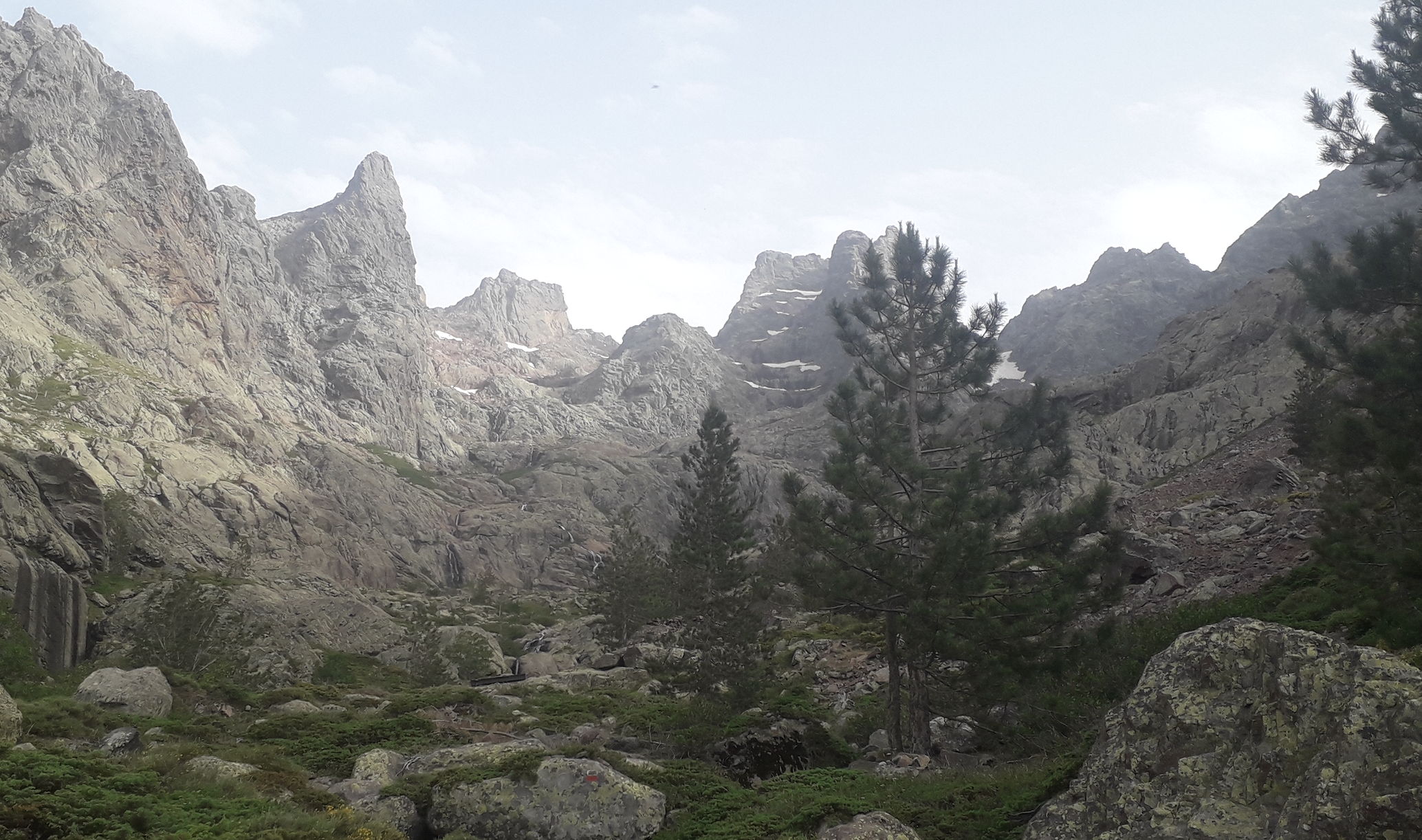
Two hikers passed as I woke up. It was not even six o'clock in the morning, but not wanting to be spotted by too many people, I decided to pack my belongings as quickly as possible. The trail followed the river along the valley until it turned right towards the Bergerie de l'Inzecche, then left again towards the Lake of Ninu. Only the bark of a dog pierced the silence, and I could make out the two young walkers I had encountered while still half asleep. Like the previous valley, the area around the lake was covered in pozzines and enclosed by gentle slopes, giving it the characteristic U-shape carved by glaciers, since even Corsica's mountains were buried under massive ice sheets during the ice ages. After passing the lake, I pressed on west, leaving the valley behind as I climbed towards the Bocca à Réta. The area was sparsely vegetated, with only a few trees poking up here and there. Following the mountain flank to the Col di San-Pietru, the path descended north, and before long I found myself in dense pine forest once more. I reached the hotel Castellu di Vergio located along the D84 road around 9 am, just in time for breakfast. While ordering a cappuccino and a pain au chocolat, I was relieved to see a small shop selling sports gear. They also had hiking socks, which I badly needed, as I had forgotten to pack two extra pairs. My socks, which were not adapted for hiking long distances, were now worn-out, crusty and brown. I did not hesitate to buy a pair, proudly labelled "Made in France". My old socks in tatters, I tossed them in the nearest bin with a sense of satisfaction before enjoying my early lunch. I felt a massive surge of relief as I put on my new pair of socks. I had no blisters, but it felt as though my feet were now wrapped in a cushioning blanket, and I honestly felt as if I were lying in a cosy bed. All the growing reluctance to walk further, caused by the increasing friction I had felt with every step of this hike, was now utterly gone. Eager to try them out in the field, I shouldered my backpack once more and went to find the trail. After only a few steps, I could not help letting out a fiery “chehoo” and breaking into a run down the narrow path through the pine forest. A sign marked “UTC 110” was posted there: the gruelling 110 km ultra-trail crossing Corsica’s mountains, which shares this section with the GR 20. Perhaps a project for another time, I thought to myself. It didn’t take me long to reach the Bergeries de Radule, which lay right above the green canopy of pine trees, next to a mountain torrent. Hikers were enjoying their early lunch at the outside tables, taking in the view over the forested valley, while others bathed in one of the many natural pools. I simply soaked my bandana in the cold water and put it back on, enjoying it running down my back and soaking my shirt. I pressed on, climbing up the now steep trail along the torrent towards the Refuge Ciuttulu di i Mori. I took great pleasure in dashing across the mountain’s solid rock, with its gentle angles and rounded forms. I finally left the stream, turned left and then right, and walked high above the valley on grassy patches and the usual craggy boulders. Their texture fascinated me, as they appeared to contain almandine, the iron-rich type of garnet, an indicator that the rock here must have undergone intense pressure in the past. I knew that Corsica once sat on France’s southern coast before it began its southeastern odyssey across the Mediterranean Sea. I concluded that the driving force must have been the formation of the Alps, before Corsica’s landmass left the continent to become the island we know today. As I inspected the rocks I wished I had my geological hammer with me, which, of course, I did not.(...)